
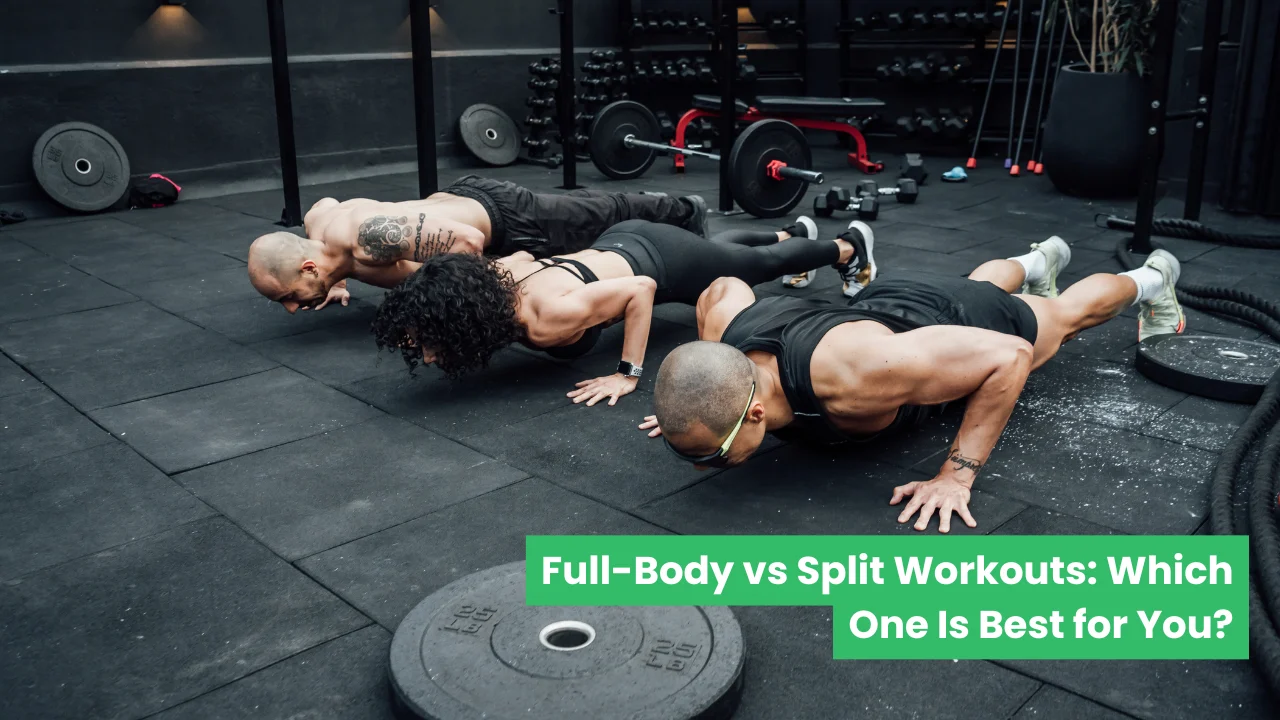
The debate between full-body workouts and split routines is one of the oldest in fitness. Each approach offers clear benefits, but the right choice depends on your goals, time, and experience level. For some, training the whole body in one session brings balance and efficiency. For others, targeting specific muscles through splits provides better control and growth.
Understanding the difference between these two training systems helps you build a workout plan that fits your lifestyle and ensures long-term results.
Key Takeaways On Full-Body vs Split Workouts
- Full-body workouts train all major muscle groups in one session, ideal for busy people or beginners.
- Split workouts divide training days by body part or movement pattern, best for building size and strength.
- Full-body plans improve overall fitness and calorie burn; splits help refine and isolate specific muscles.
- The best routine depends on your goal fat loss, endurance, or muscle hypertrophy.
- Both approaches can be effective if planned with proper rest and consistency.
Understanding the Basics
A full-body workout targets your upper body, lower body, and core in one session. It uses compound exercises like squats, deadlifts, push-ups, and pull-ups, which work multiple muscles together. This makes it efficient, especially for people with limited time.
On the other hand, a split workout divides sessions by muscle groups or movement types. For example, you might train chest and back on one day, legs and core the next, and arms and shoulders after that. Each muscle group gets deeper attention and more recovery time before being trained again.
Both systems are effective, but they serve different fitness needs. A full-body routine improves functional strength and endurance, while split training helps in building muscle mass and symmetry.
Benefits of Full-Body Workouts
Full-body workouts offer simplicity and efficiency. Every session trains your entire body, so even if you miss a day, you still hit all muscle groups for the week. This approach is especially useful for people with busy schedules or inconsistent training availability.
Another major benefit is balanced development. Full-body sessions prevent neglecting smaller muscles or missing key areas like legs or back. They also help avoid muscle imbalances that can lead to injuries.
These workouts also elevate your heart rate, since several large muscle groups work together. The result is an improvement in strength and cardiovascular health at the same time. For anyone aiming to burn calories and build lean muscle, full-body routines deliver both.
Who should choose it:
- Beginners building foundational strength.
- People training 2–3 times a week.
- Those aiming for fat loss or overall fitness.
- Individuals needing more rest and recovery between sessions.
Example Full-Body Routine
| Exercise | Sets | Reps | Focus |
|---|---|---|---|
| Squats | 4 | 8–12 | Legs & Core |
| Deadlifts | 3 | 8–10 | Back & Glutes |
| Bench Press | 4 | 8–12 | Chest & Shoulders |
| Pull-Ups | 3 | Max | Back & Arms |
| Overhead Press | 3 | 8–12 | Shoulders |
| Plank | 3 | 45 sec | Core Stability |
Perform this routine 2–3 times per week with at least one rest day between sessions.
Advantages of Split Workouts
Split training allows focused work on specific muscles. By dedicating full sessions to one or two areas, you can increase volume and intensity, leading to greater muscle hypertrophy (growth). This is why most advanced bodybuilders follow split programs.
For example, one day might target chest and triceps, while another works back and biceps. The goal is to fully exhaust the muscle fibers in that area before moving on. This approach helps correct weaker areas and allows you to sculpt your physique more precisely.
Split workouts also provide ample recovery time for each muscle group. Since you don’t work the same muscles daily, they have time to repair and grow stronger between sessions.
Who should choose it:
- Intermediate or advanced lifters.
- Those training 4–6 days a week.
- Individuals focused on strength or muscle mass.
- Athletes aiming for targeted development.
Example Split Routine (5-Day Plan)
| Day | Focus Area | Example Exercises |
|---|---|---|
| Day 1 | Chest | Bench Press, Incline Dumbbell Press, Cable Flys |
| Day 2 | Back | Deadlifts, Pull-Ups, Seated Rows |
| Day 3 | Legs | Squats, Lunges, Calf Raises |
| Day 4 | Shoulders | Overhead Press, Lateral Raises, Shrugs |
| Day 5 | Arms | Bicep Curls, Tricep Dips, Hammer Curls |
This classic “bro split” approach ensures every muscle group gets full attention during the week.
Choosing the Right Training Style
Your choice between full-body and split training should match your fitness level, schedule, and goals. If you can train only a few times a week, full-body sessions give the best return. They cover everything in less time and improve overall conditioning.
If you enjoy longer gym sessions or want to maximize muscle growth, splits are more effective. They allow for detailed work on each area, better mind-muscle connection, and tailored recovery.
However, the best plan is one you can maintain. Consistency matters more than any single workout structure. Many athletes even combine both systems starting with full-body routines to build a base, then moving to splits for targeted progress.
Combining Both Approaches
You don’t always have to choose one method forever. A balanced mix of full-body and split sessions can keep training interesting and prevent plateaus.
For instance:
- Monday: Full-body compound workout
- Wednesday: Upper-body split
- Friday: Lower-body split
This mix offers both efficiency and depth, supporting strength, endurance, and muscle development together. It’s also adaptable to time constraints or changing goals.
Conclusion
Both full-body and split workouts can help you get stronger and fitter. The real question isn’t which one is “better,” but which one fits your lifestyle and keeps you consistent. Full-body routines provide balance and efficiency, while splits allow precision and growth.
If your goal is general fitness or fat loss, start with full-body workouts. If you want to build serious muscle or focus on specific areas, a split plan is the smarter choice.
Remember, the most effective workout is the one you can sustain. With clear goals and regular effort, either path can lead to lasting strength and visible results.














1 thought on “Full-Body vs Split Workouts: Which One Is Best for You?”